Battery Capacity Grading Cabinet
High-precision charge and discharge testing equipment for lithium battery cell capacity grading.
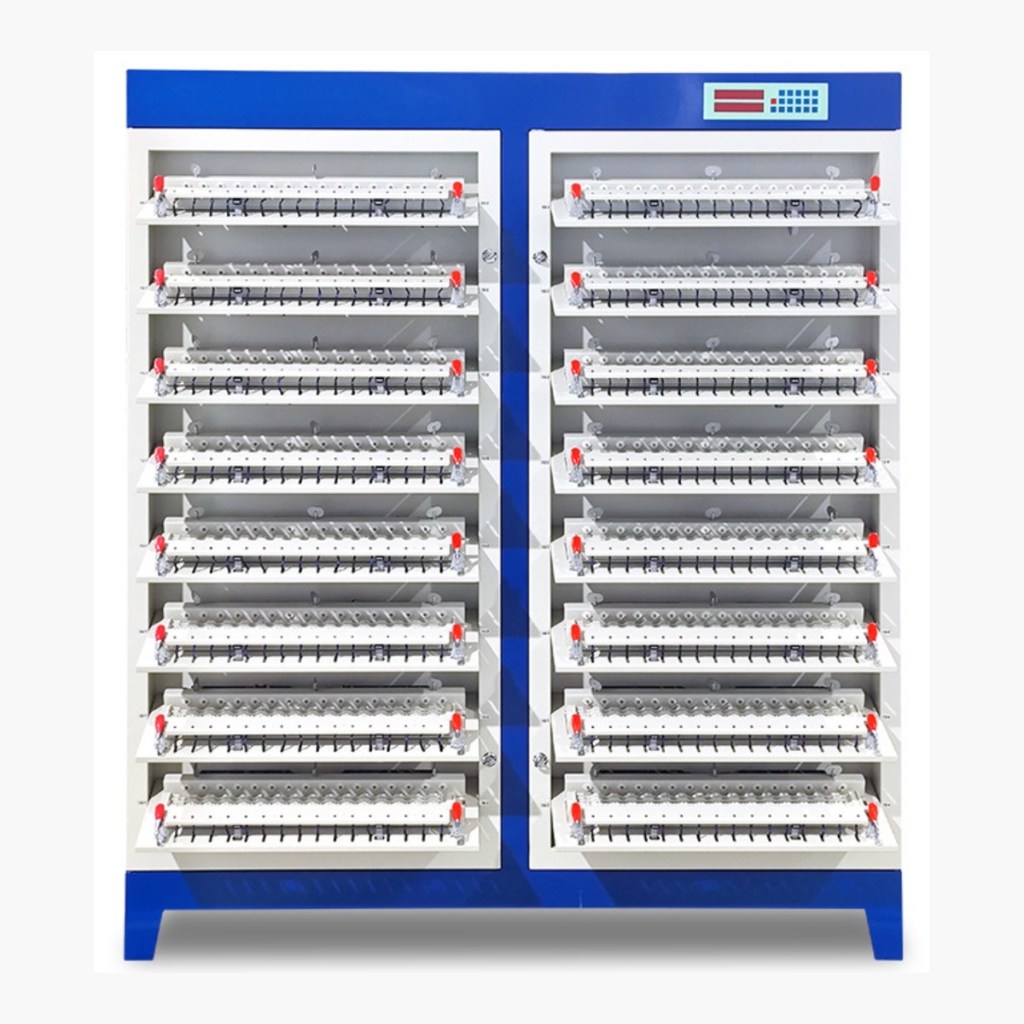
The Battery Capacity Grading Cabinet is designed for charge and discharge testing, capacity grading and performance evaluation of lithium battery cells. It helps manufacturers identify cell capacity differences, improve cell consistency and ensure stable battery pack quality before assembly.
- Charge & Discharge – Testing Supports accurate charge and discharge testing for lithium battery cells.
- Capacity Grading – Classifies cells by capacity to improve battery pack consistency.
- Multi-Channel Design – Supports multiple testing channels for efficient batch processing.
- Data Management – Test data can be recorded, exported and used for quality traceability.
- Customization Available
Key Features
Modular design with strong compatibility and easy maintenance.
Four-wire measurement method is adopted to improve testing accuracy.
Each battery channel is equipped with an independent constant-current and constant-voltage source, forming an independent circuit without interference between channels.
The equipment adopts a complete machine process control mode for stable and efficient operation.
Fast sampling speed. The full cabinet inspection cycle time is ≤3 s.
Windows-based software with powerful functions, user-friendly interface and simple operation. The host computer can set up to 32 work steps and 256 cycles. Each formation step supports constant-current charging, constant-voltage charging, constant-current discharging and resting modes.
Real-time dynamic curves can be generated during the battery formation and capacity grading process, including voltage-time curve, current-time curve, capacity-time curve, energy-time curve and capacity-voltage curve.
LED indicators are used to display the working status of each battery cell.
Communication method: RS485.
Each host computer can monitor up to 20 units of equipment. It is recommended to monitor 10 units for stable operation.
Data power-off protection function is available. The equipment can continue operation after power is restored.
The software supports editing and modification of formation and capacity grading process library files, as well as functions such as creating new monitoring files, opening and closing documents, printing and parameter setting.
Technical Specifications
| Item | Specification |
| Model | 5V 30A 128CH |
| Number of Channels | 128 Channels |
| Charge / Discharge Current Range | 300–30000 mA |
| Current Measurement Accuracy | ±0.05% FS + 0.05% RD |
| Current Resolution | 1 mA |
| Voltage Measurement Range | 0–5000 mV |
| Charging Voltage Range | 0–4500 mV |
| Discharging Voltage Range | 1800–4500 mV |
| Voltage Measurement Accuracy | ±0.05% FS + 0.05% RD |
| Voltage Resolution | 0.1 mV |
| Time Measurement Range & Accuracy | 999 minutes per step, accuracy ±0.1% |
| Calibration Method | Software digital calibration |
| Calibration Cycle | 6 months |
| Working Steps | Constant-current charging, constant-current and constant-voltage charging, constant-current discharging, resting |
| Step End Conditions | Current, voltage, time and capacity |
| Maximum Number of Steps | 32 |
| Maximum Number of Cycles | 256 |
| Curve Display | Charge/discharge current curve, charge/discharge voltage curve and capacity curve |
| Capacity Grading Methods | Capacity grading, time grading, capacity + curve grading, time + curve grading, capacity + voltage grading and fixed-point voltage grading |
| Protection Functions | Over-current, under-current, over-voltage, under-voltage, over-capacity and leakage current protection. Charging over-voltage and discharging under-voltage are protected by both hardware and software. |
| Data Statistics | Open-circuit voltage, average voltage, working time, current, capacity and platform capacity of each battery cell at each step; detailed curves and data of each step; quantity statistics of cells in each capacity range. |
| Inspection Speed | ≤3 seconds |
| Communication Method | RS485 |
| Battery Barcode Scanning Function | Supports barcode scanning for both 1D and 2D codes. Sequential scanning and channel-jump scanning are supported. Battery barcode information can be bound to equipment channel information for easy traceability. Wireless barcode scanners can be supplied according to the user’s solution requirements. |
| Data Processing Function | Local Data: Detailed operating data of the equipment can be stored locally and will not be deleted. One data file is generated for each process run, and the data files can be copied to other computers for viewing. Result data can also be stored locally and will not be deleted. One MDB file is generated for each process run, and the result data file only stores the final data of each work step. |
| Server Data | When a data server is configured, result data can be uploaded to the server database. The storage period can be set according to customer requirements. The MDB file uses a standard database format and can be connected with the MES system. |
| Number of Devices Controlled by Each Computer | 1–20 units; 10 units are recommended. |
| Rack Dimensions | 2030 mm × 700 mm × 2020 mm |
| Total Equipment Power | ≤23 kW |
| Power Supply Efficiency | The charge/discharge power supply adopts an energy-saving design. The discharge energy of the battery can be fed back to the power grid. The maximum charging output efficiency is not less than 70%, and the maximum energy recovery efficiency is not less than 65%. |
| Equipment Stability | The equipment provides good long-term operating stability. After accuracy calibration, it can ensure that the accuracy remains within the specified control range for 6 months. |
| Working Power Supply | Three-phase AC380V ±10%, 50Hz |
Energy-Saving AC/DC Bidirectional Power Supply
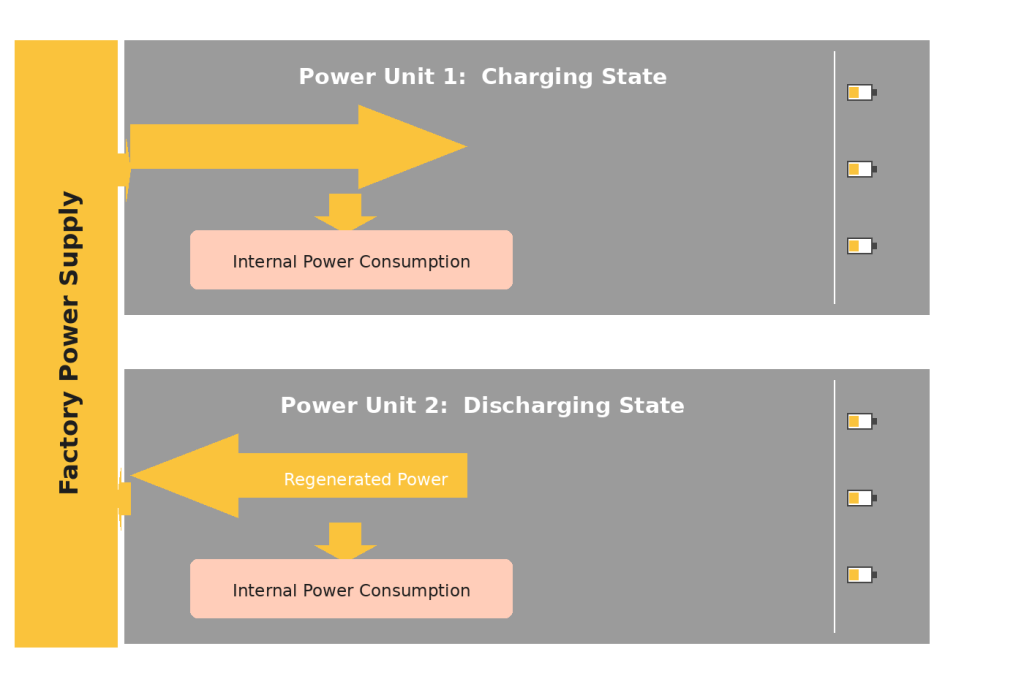
The equipment adopts an energy-saving AC/DC bidirectional power supply with high charging efficiency. During battery discharge, part of the discharged energy can be reused by the internal power supply system, part can be supplied to other charging equipment, and the remaining energy can be fed back to the power grid, helping reduce energy consumption and improve overall operating efficiency.
Main System Configuration Requirements
The computer should be equipped with a CPU above P4, more than 2 GB of memory, more than 200 GB of hard disk space, an EGA/VGA color display, one CD-ROM drive, one mouse, Microsoft™ Windows 7 or above operating system, one available RS232 serial communication port, and a Windows-supported printer.
The computer system shall be provided by the customer, and the number of computer systems shall be determined according to actual requirements.
 FLYAIR